Quiz 3, with solutions
Useful equations provided with the quiz included , , , and (the last carrying a correction from the original quiz).
A trip around the PV graph
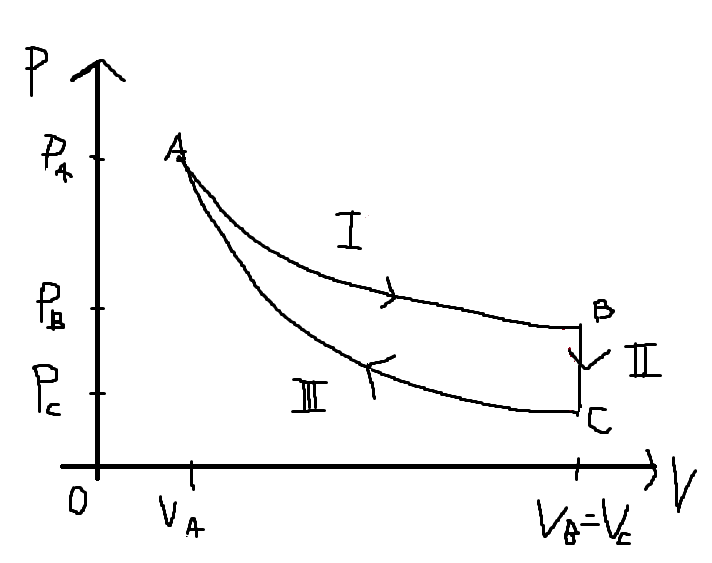
The figure shows the pressure-volume state of an ideal gas along three different paths I, II, III. Express your answers with the given variables and/or universal constants.
(a) Suppose moles of an ideal gas undergo a reversible isothermal expansion at temperature along path I. Determine the heat released or absorbed by the gas.
Solution. We begin with the first law of thermodynamics, . For a reversible isothermal expansion , and therefore . For an ideal gas, the pressure-volume work for a reversible process is given by
Solving the integral, we get
(b) Determine the change in internal energy and change in enthalpy along path I.
Solution. We know that for an isothermal process . Starting from the definition of enthalpy, , and for an ideal gas . Consider the change . Since all quantities on the right hand side remain constant, .
(c) Determine the change in entropy along path I.
Solution. To obtain the change in entropy we begin with , where means we need a reversible heat for the desired process. From part (a) we found the heat along path I, and it is indeed reversible. Combining the equations, we get
(d) Consider path II from point B to C, where the gas is cooled reversibly at constant volume from to . Determine the heat released or absorbed during the process. Let the heat capacity at constant volume of the gas be .
Solution. For the heat of a constant-volume process we use the definition of heat capacity, , which integrates to .
(e) Consider path III from point C to A, where the gas goes through an irreversible adiabatic process (i.e. no heat exchange). Determine from point C to A.
Solution. Recall that is a state variable, which means it does not matter how we go from C to A. Since we have not learned much about irreversible, let alone adiabatic, processes, it is best we choose a path that is familiar to us. We can combine our answers from previous parts, writing
For we determined the heat in part (d), and the work for a constant-volume process is 0, hence , with the negative sign because we reverse the process of part (d). From B to A, . Therefore
(f) Determine from point C to A.
Solution. Similar to part (e), is a state function, so we disregard the complicated irreversible adiabatic path and instead choose the path that we have already solved. From C to B we have . Dividing both sides by and integrating (the process is reversible, so is ),
From B to A, part (c) gives , so . Altogether
Remark. To determine entropy you must find a reversible path. The adiabatic () path does not imply , because that is irreversible.
Bonus
Interpret the change in entropy from point A to B above using the concept of microstates.
Solution. The fundamental definition of entropy relates to microstates according to . From A to B we increase the volume, hence the number of available configurations (microstates) the gas can arrange itself in increases, and entropy increases.