Boron Nitride and Bilayer Graphene
From a tight-binding problem set, computed with PythTB.
The honeycomb lattice has two sites per unit cell, call them A and B, and the simplest tight-binding model hops an electron only between neighboring A and B sites with amplitude . The differences among graphene, boron nitride, and their stacks all come down to those two sublattices.
Sublattice asymmetry
In graphene the two sublattices are both carbon, their onsite energies are equal, and nothing distinguishes A from B. The two bands then touch at the corners of the Brillouin zone, the K points, and the spectrum is gapless. Hexagonal boron nitride has the same lattice but boron on one sublattice and nitrogen on the other, which the model captures with onsite energies and (the calculation uses with ). The bands become
where is the sum of hopping phase factors over the three A-B bonds. At the K points vanishes, and hBN therefore has a gap of where graphene has band touching. Sampling the bands on a k-mesh and histogramming the eigenvalues gives the density of states, and the gap is unmistakable.
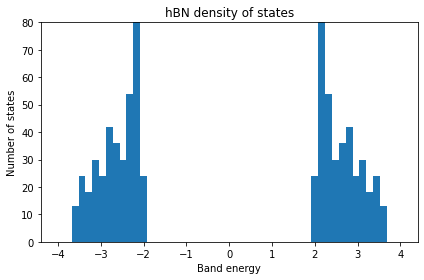
Graphene conducts and boron nitride insulates on the same lattice with the same bonds, because a gap opens once the two sublattices are inequivalent.
Bernal-stacked bilayer
The second modification keeps both sublattices carbon but stacks a second graphene layer in the Bernal arrangement, where one sublattice of the top layer sits directly above a sublattice of the bottom layer. Those aligned atoms couple with an interlayer hopping , and the four bands work out to
with the same in-plane factor as before (the calculation uses ).
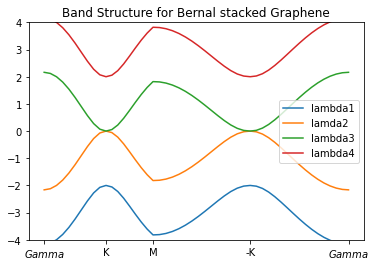
Two of the four bands are pushed away from zero energy by , and the two that remain still touch at K, but the touching changes character. The monolayer’s linear Dirac cones become parabolic band touching in the bilayer, which is why monolayer and bilayer graphene have qualitatively different low-energy electrons even though both are gapless. A gap can then be opened in the bilayer by an electric field between the layers, which plays the same symmetry-breaking role that the boron-nitrogen difference plays in hBN.
Feel free to contact me if there is an error or confusion!