Local-correlation ML
CCSD(T) is quantum chemistry’s accuracy standard and too expensive to run routinely. This project asks whether the cheap byproducts of a local-correlation calculation, pair natural-orbital occupations and MP2 pair energies, carry enough signal for a small model to predict the full CCSD(T) correlation energy. Every pass/fail criterion was locked in writing before scoring, and negative results are reported at full weight.
Background
Wavefunction methods decompose the correlation energy over pairs of occupied orbitals. The decomposition is written as
where is the contribution of the electron pair occupying orbitals and . Local-correlation methods such as DLPNO exploit this structure by compressing each pair’s virtual space into a small set of pair natural orbitals. The PNO occupation numbers measure how compressible each pair’s correlation is, and the same calculation produces semicanonical MP2 pair energies as a byproduct. Both quantities exist before the expensive coupled-cluster iterations begin, and they are therefore natural inputs for a surrogate model. Because the first feature is the semicanonical MP2 total, the trained model acts as a molecule-level MP2-to-CCSD(T) corrector, in the spirit of Delta-learning, where a model predicts only the gap between a cheap method and an accurate one.
The main model is Gaussian process regression. Given a training kernel matrix , labels , and noise variance , the prediction at a new molecule is written as
where collects the kernel values between and the training molecules. The variance is the model’s own uncertainty estimate, and the later rounds of the project test how far it can be trusted.
Features and models
The features come from DLPNO calculations in the cc-pVDZ basis, and the labels are the released QM7b-T CCSD(T) correlation energies over 7211 thermalized small organic molecules. The per-pair table is reduced to twelve fixed molecule-level aggregates, sums and moments of the occupations and pair energies, and a Matern-5/2 GP with per-dimension length scales is trained on them. Against it stand a per-pair neural ansatz that scales each MP2 pair energy by a learned factor, a free-form DeepSets network that learns its own aggregation, and controls including a nearest-neighbor lookup and a base-only ablation with the PNO features removed.
Pre-registration
The 1.0 kcal/mol accuracy bar, the splits, the composition holdout classes, and the interpretation bands for each follow-up experiment were frozen in writing before the corresponding runs, and fourteen pre-registration documents ship with the repository.
Results
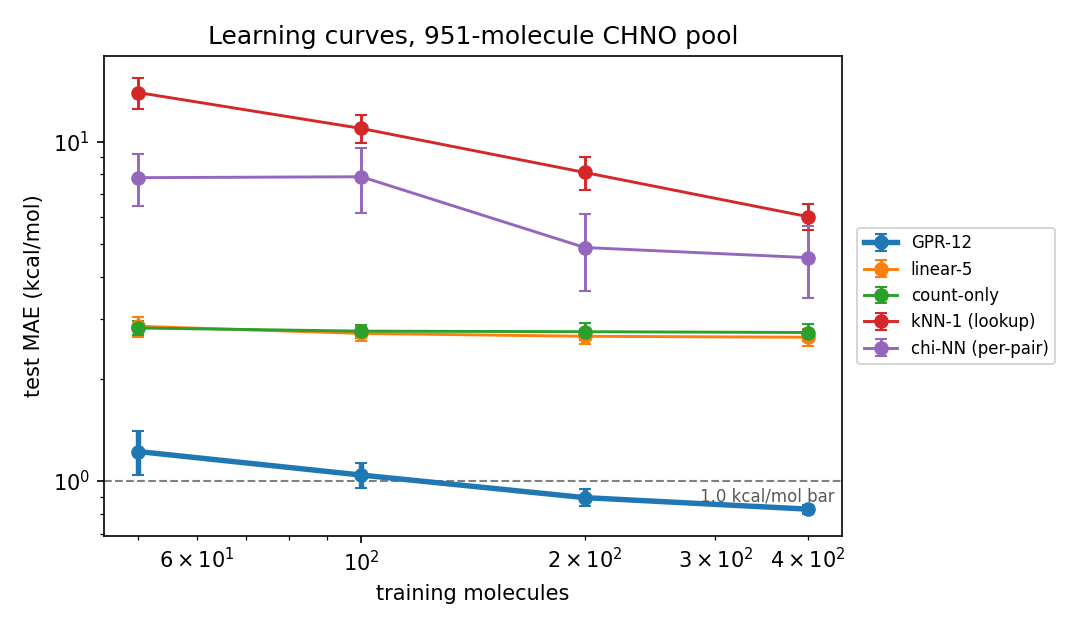
A Gaussian process on twelve physics-motivated aggregates reaches 0.83 kcal/mol at 400 training molecules, under the pre-registered 1.0 kcal/mol bar, and stays near 1.0 on held-out composition classes. The per-pair neural ansatz the project was built to test fails at 4.55 kcal/mol under the registered protocol, and a free-form DeepSets never catches the hand-crafted features even at 6000 molecules on fully public data. The base-only ablation degrades to 1.82 kcal/mol, and the signal therefore sits in the local-correlation intermediates rather than the MP2 base alone.
Uncertainty
The uncertainty rounds are the practical payoff. The model’s own variance ranks molecules from an unseen element regime almost perfectly, at AUROC 0.977 on sulfur- and chlorine-containing molecules, but its error bars are wrong there, and all three label-free recalibration methods registered for the problem fail. About ten labels from the new regime restore trustworthy bars, and spending the first labels from the new regime on training beats spending them on calibration. Variance-greedy acquisition also helps in distribution, where greedy selection at 200 labels roughly matches random selection at 400.
Repository
The repository ships the frozen pre-registration documents, the committed results, and a test suite that machine-checks every number quoted in the README against them. Two arms, the crossover study and the Miller-substrate control, run end to end against the public QM7b-T release.