Second cumulant of the electron density
A functional can get the energy right and still get the electron density wrong. This benchmark judges DFT on the density itself, comparing dipole moments, quadrupole moments, and the density’s overall spread (the second cumulant) against CCSD(T) references across small molecules and radicals.
Background
Density functionals are usually ranked by the energies they predict, and error cancellation lets a functional land good energies on top of a distorted density. Moments of the density offer a direct test of the density itself. The dipole moment is the first moment, and it vanishes by symmetry for many molecules. It therefore says nothing about whether a symmetric density is too diffuse or too compact. Higher moments carry that information, but the raw second moment shifts when the coordinate origin moves, which makes comparisons between methods ambiguous. The paper’s title asks whether DFT densities come out too big, too small, or just right, and answering that requires a spread measure that does not depend on where the molecule sits.
Second cumulant
For a system of electrons with density , define the density average . The second cumulant is the matrix of spatial variances, written as
Shifting the origin changes both terms by the same amount, and is thus translationally invariant even though the raw second moment is not. Its diagonal measures how far the electron cloud spreads along each axis, and its trace gives a single origin-free number for the overall size of the density. A functional whose trace runs too large predicts a density that is too diffuse, and one whose trace runs too small predicts a density that is too compact.
Benchmark
The study benchmarks 47 density functionals, grouped by Jacob’s ladder rung, over 100 small molecules. For each species the dipole moment, the quadrupole moment, and the second cumulant are compared against CCSD(T) reference values converged through the aug-cc-pcVTZ, QZ, and 5Z basis sets. The reference cumulants form the paper’s Var213 dataset of 213 independent components.
Pipeline
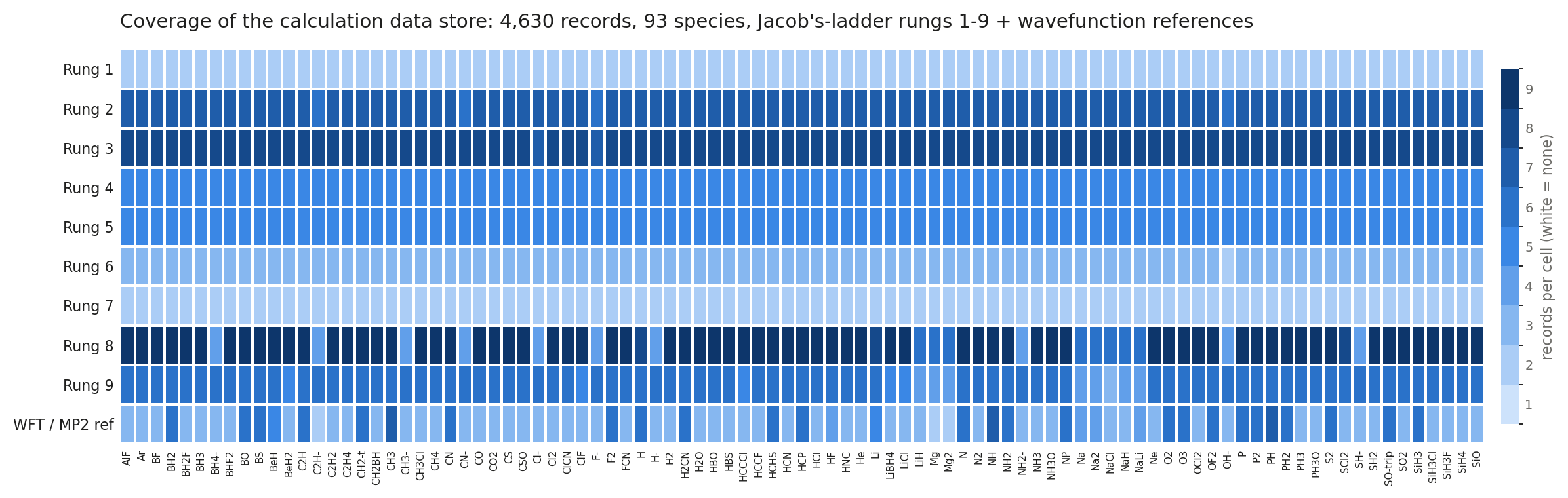
This repository is the pipeline behind the paper. It holds the molecular geometries and Q-Chem input files, an annotated input template encoding the SCF convergence settings, and a functional registry (jacob_ladder.json) that organizes the functionals by ladder rung. Raw Q-Chem outputs from the HPC runs feed extraction scripts, which populate a versioned JSON document store of the calculation records. An analysis notebook reads the store and produces the tables, figures, and functional rankings that appear in the paper.
Provenance
It began as my undergraduate research in the Head-Gordon group at Berkeley and became an equal-contribution first-author paper with Diptarka Hait.