Lithium in graphitic carbon
First-principles modeling of lithium-ion batteries leans almost entirely on semilocal DFT, and inside a periodic calculation its accuracy is hard to check. This project builds a ladder of molecular stand-ins for lithiated graphite, small enough for coupled-cluster benchmarks and large enough to approach graphitic behavior, and uses it to test the workhorse functionals against wavefunction theory.
Background
A graphite anode stores lithium between its carbon sheets. On charging, lithium ions cross the electrolyte and slot into the interlayer galleries, and on discharge they leave again. Two quantities govern the electrode. The thermochemistry of intercalation sets the voltage the cell delivers, and the barrier a lithium crosses when it hops between neighboring interlayer sites sets how fast the electrode can run.
For a host with carbons and a single lithium, the discharge energy per lithium is written as
where each term is a total electronic energy and is that of the lithium reference. The diffusion barrier compares the transition-state geometry of a hop with the adjacent minimum and reads
In practice both quantities come from semilocal density functionals, and the physics here touches their known weak spots. Lithium between the sheets transfers charge to the carbon, the sheets bind partly through dispersion, and different functionals treat both effects differently. In a molecule the disagreement can be settled against coupled cluster. In a periodic crystal that check is largely out of reach.
Cluster ladder
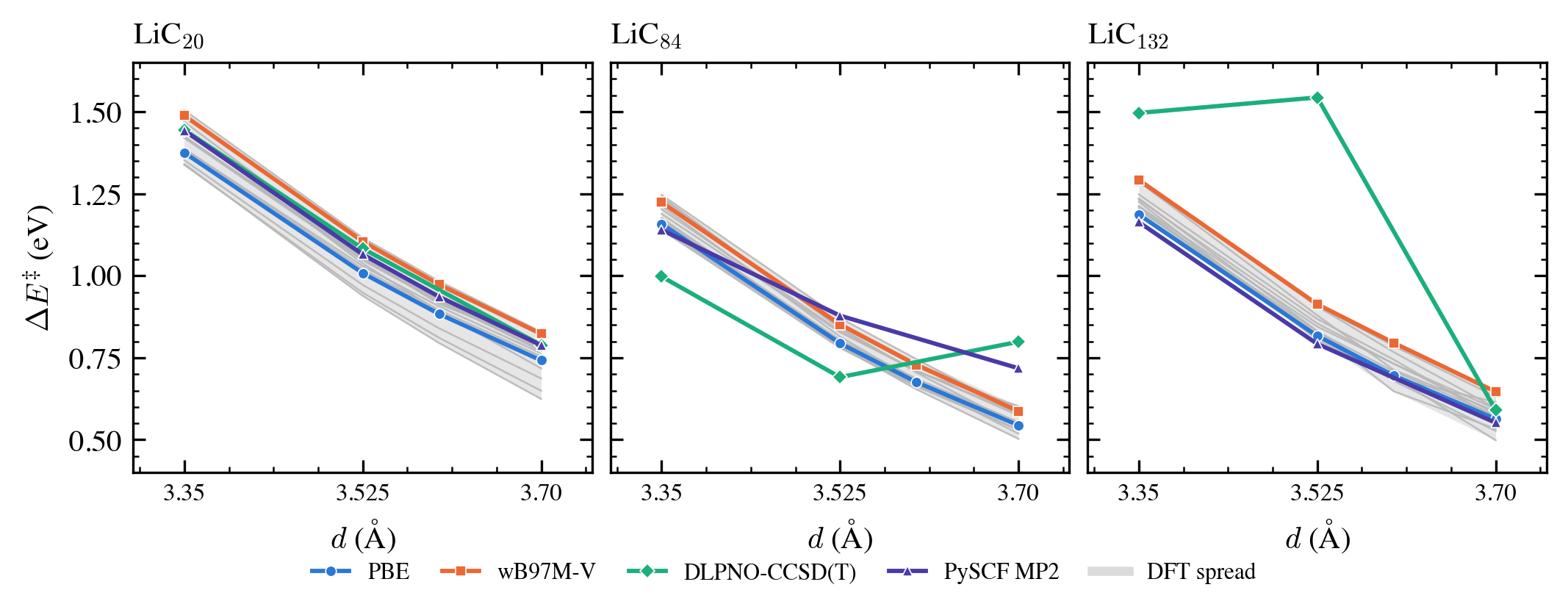
The stand-ins are AA-stacked aromatic bilayers with a lithium between the sheets, grown from LiC20 to LiC132. The lithium count stays at one while the sheets enlarge, and the series thus walks toward the dilute limit of the periodic material, with its convergence visible along the ladder. The largest cluster reproduces a periodic dilute-limit reference (0.617 eV) to better than 0.01 eV when both are computed with matched settings, which anchors the molecular ladder to the crystal it stands in for.
Findings
Fifteen functionals agree to about 0.1 eV on the diffusion barrier but scatter by 0.3–0.45 eV per lithium on the discharge energy, and a spread in energy per lithium carries directly into the predicted voltage. That makes the thermochemistry the more discriminating target for benchmarking.
The wavefunction side needed the most care. A cluster holding one lithium between closed-shell sheets is an open-shell doublet, and an unrestricted mean-field reference for a doublet can mix in higher spin states. A coupled-cluster calculation built on such a contaminated reference inherits the distortion, and here it can inflate a barrier by as much as 0.8 eV, far larger than the spread among the functionals on the same quantity.
Dataset
Behind the numbers sits a provenance-audited dataset of 566 calculations and 234 barriers across four campaigns. Every accepted output is gated on completion and geometry checks, since at this volume a truncated job or a drifted geometry would otherwise slip into the analysis unnoticed. With Zachary Goldsmith, Hong-Zhou Ye, and Tim Berkelbach. A manuscript is in preparation.